Find Your Meter and Read It
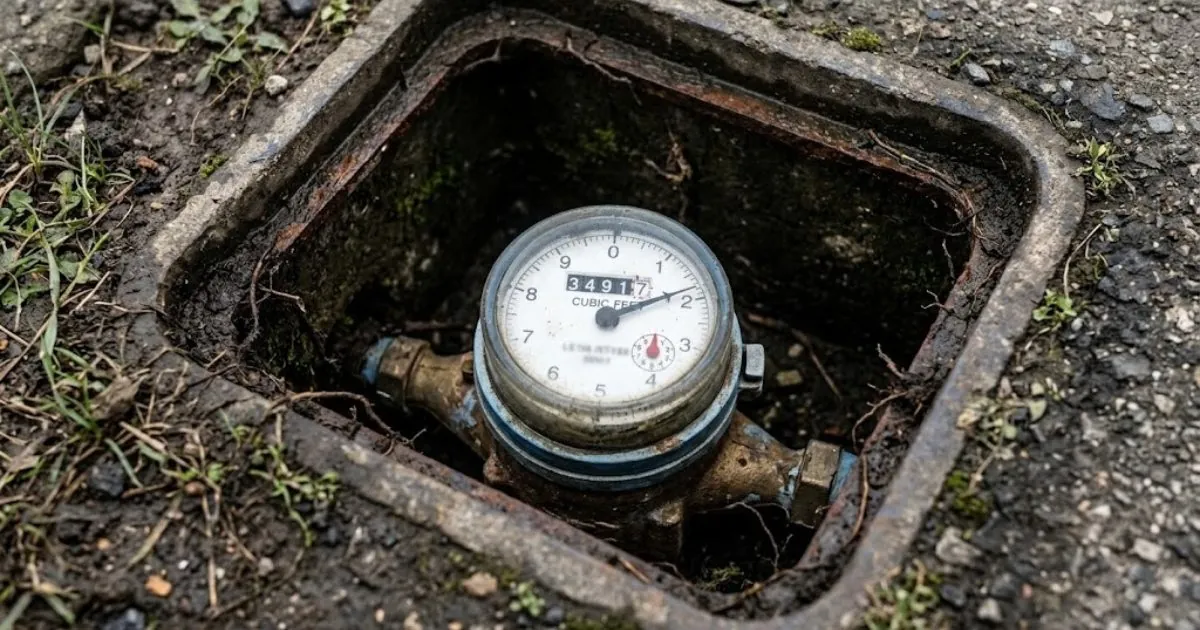
Most meters sit in a box in the ground near the street or the property line, with a lid you can lift with a screwdriver. Wear gloves and watch for insects and spiders. Inside you will find a dial with numbers, and often a small triangle or wheel called the low-flow indicator that spins when any water moves.
Turn off every faucet, ice maker, irrigation timer and appliance that uses water. Look at the low-flow indicator. If it spins or the dial moves, water is leaking. Take a photo of the reading and the time.
The Three-Zone Test
Close the main valve at the house
Find the shutoff where the line enters the house, often at the front wall, in the garage or at a utility closet.
Check the meter again
Wait ten minutes. If the indicator stops, the leak is inside the house. If it still moves, the leak is between the meter and the house.
Reopen the valve and test fixtures
If the leak is inside, shut off the water to individual fixtures, like toilets and the water heater, and watch the meter after each.
Check the yard
Look for wet spots, soft ground or unusually green grass along the line from the meter to the house.
| Result | Leak zone | Next step |
|---|---|---|
| Meter stops with the main closed | Inside the house | Check toilets, water heater, softener, ice maker |
| Meter keeps moving with the main closed | Buried service line | Call for line locating, see water line repair |
| Meter moves only when the irrigation is on | Irrigation system | Isolate zones |
| Meter moves a little, constantly | Toilet flapper or small drip | Dye test the toilets |
| Meter moves, floor is warm | Hot-water line under the slab | Call for slab leak detection |
Meter Still Moving?
Call and share your reading. A plumber can plan the right test.
Check the Toilets First
The most common cause of a slow meter creep is a toilet. A worn flapper lets water seep from the tank into the bowl all day. Add a few drops of food coloring to each tank, wait fifteen minutes without flushing and look at the bowl. Color in the bowl means the flapper leaks. A new flapper is a cheap fix.
Other Common Indoor Culprits
- A water heater relief valve that drips or a tank leaking at a fitting.
- A water softener that cycles constantly.
- An ice maker or refrigerator line.
- A dripping faucet or shower valve.
- A leaking supply line under a sink.
- A dishwasher or washing machine hose.
Look in cabinets and behind appliances for dampness. Run a dry paper towel along each supply line and check it for moisture.
If the Leak Is Outside the House
A line from the meter to the house is usually the homeowner's responsibility. The utility owns the meter and the connection on its side. A leak in the buried line can run for weeks before you see it. Our water line repair page explains how the line is located and repaired.
Moncks Corner Notes
Moncks Corner sits about 33 feet above sea level near the Cooper River and gets roughly 52 inches of rain a year. Wet soil hides a leaking line. A soggy yard after a week of dry weather is a stronger clue than a soggy yard after a storm.
Water service comes from either the Moncks Corner Public Works Commission or Berkeley County Water and Sanitation, depending on your address. Call your utility to ask about a leak adjustment policy and how they read meters. Do not assume a high bill will be forgiven, since policies differ.
If the Leak Is Under the Slab
A warm spot on the floor, the sound of running water or a meter that keeps moving after you have ruled out toilets and the yard suggest a slab leak. Read our guide to slab leak repair for how those are found and fixed.
When to Call a Plumber
- The meter still moves after you checked toilets and fixtures.
- You see water in the yard, a damp wall or a warm floor.
- You cannot find the main shutoff.
- Your water bill has jumped and you are unsure why.
Our leak detection service uses meter tests, pressure tests and listening gear to locate leaks before anything is opened. If you live near Goose Creek, the Goose Creek page covers our service area. If water is actively running, shut off the main and call the 24/7 line.
Reading the Meter Like a Pro
Most meters have a sweep hand or a numeric dial in gallons or cubic feet. Take a reading, wait fifteen minutes with all water off and read again. The difference tells you how much water leaked. A difference of a few gallons points to a toilet. A difference of tens of gallons points to a pipe.
Write down the readings with the time. If you need to ask the utility about an adjustment, those numbers help. Plumber notes and repair receipts also help.
Why Small Leaks Matter
A leak of one gallon an hour sounds minor, but it adds up to more than seven hundred gallons a month. That is enough to show on the bill and enough to damage a wall or a subfloor. The sooner you act, the smaller the repair.
Standards and Sources
The EPA's WaterSense program estimates that the average household's leaks waste nearly 10,000 gallons of water a year, so a moving meter is worth chasing.
Water Meter Leak Questions
No. Any movement with all water off indicates water is leaving the system, though the low-flow indicator can spin for a very small drip.
Often at the front wall of the house, in the garage or in a utility closet. Locate it before an emergency and test that it turns.
Yes. A leaking flapper can waste many gallons a day without noise.
Usually the homeowner. A plumber can locate and repair the line.
Policies vary by utility. Ask yours directly and keep repair records.
Yes. Turn off the irrigation supply and check the meter again.