The Short Answer
| Job | Typical time | What drives it |
|---|---|---|
| Swap for a similar unit | About one hour | Same mounting ring and wiring |
| Swap with a different mount | One to two hours | New mounting assembly, new plumbing |
| First-time install, outlet in place | Two to three hours | Cutting the drain, mounting, connecting |
| First-time install, new wiring | Half a day or more | Electrical work and a switch |
| Install with a dishwasher hookup | Add about thirty minutes | Knockout plug and drain hose |
These are ranges, not promises. A plumber who sees the sink and the cabinet can give you a closer window. Our scheduling tells you when to expect the plumber, and the plumber confirms the time once the old unit is out.
What Happens During an Install
Power off and clear the cabinet
The breaker is switched off, the cabinet emptied and the old unit's wiring disconnected.
Remove the old disposal
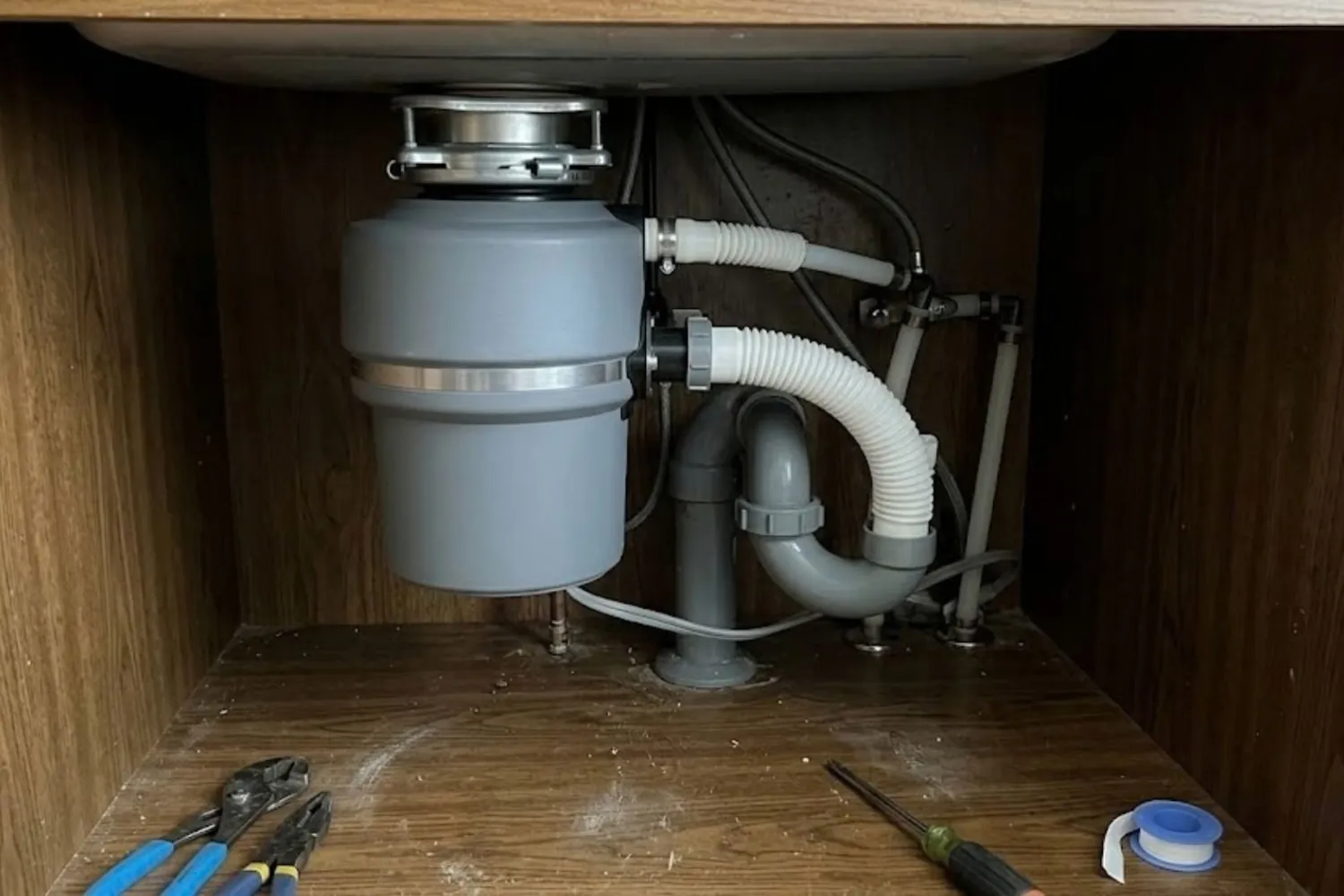
The drain pipe, dishwasher hose and mounting ring are released and the old unit lifted away.
Prepare the sink flange
The sink flange is cleaned and sealed with plumber's putty or a gasket, then the new mounting assembly is attached.
Mount the new unit
The disposal is hung from the mounting ring, aligned with the drain and tightened.
Connect drain and dishwasher
The discharge pipe is attached, the dishwasher knockout plug removed and the hose clamped.
Wire, test and run water
Power is restored. Water runs through the unit while the plumber checks for leaks.
Each step has a small job inside it. Old putty has to be scraped away, bolts may be rusted and the drain trap may not line up with the new unit's outlet.
Need a Disposal Installed?
Call to book a visit. You hear a clear price before work starts.
Why Some Installs Take Longer
- A corroded or stuck mounting ring that will not release.
- A new unit with a different outlet height that needs trap changes.
- No outlet under the sink, which means an electrician or a hardwired connection.
- A sink flange that leaks and needs resealing.
- Old plumbing under the sink that needs replacement.
- Cramped cabinets or a double-bowl sink with extra connections.
Hardwiring a disposal is common, but it must be done to code. If there is no switched outlet, the plumber will explain what is needed. Some plumbers handle simple wiring, while others bring in an electrician. Ask which applies at the time of booking.
Choosing the Right Disposal
Disposals come in a range of motor sizes. A small unit suits a household that cooks lightly. A larger unit handles more scraps and runs quieter. Continuous feed units run while the switch is on. Batch feed units run only with a stopper in place and are safer for homes with small children.
Whatever you pick, the old unit's mount may not fit the new one. Ask about the mounting style before you buy. Our page on garbage disposal repair and installation lists what we handle.
Moncks Corner Notes
Many Moncks Corner homes sit in neighborhoods built in the last two decades, since the town grew about 60 percent between 2010 and 2020 according to what officials expected from the Census. Builder-grade disposals in those kitchens are reaching the age when they start to hum, jam or leak.
If your home is on a septic system, a disposal adds food solids to the tank. Tell the plumber if you are on septic, and ask your septic service how often to pump. Ask the Town of Moncks Corner Building Department whether an electrical change needs a permit.
Before the Plumber Arrives
- Clear the cabinet under the sink.
- Find the breaker for the disposal and label it.
- Have the new unit's box and the manual on hand.
- Run the old disposal one last time to note any leak.
- Note whether you have a dishwasher connected.
Is a Quick Install Always Better
A fast install is good, but a rushed one leaks. A good plumber takes time to seat the flange properly, tighten the mounting ring evenly and test under real water flow. Leaks at the flange are the most common callback. Leaving the water on for a few minutes before packing up catches them.
If the disposal is the reason your kitchen drains slowly, a new unit may not fix it. The pipe after the disposal may be clogged. See our drain cleaning page for kitchen line clearing. Residents near Goose Creek can reach us through the Goose Creek page.
Questions About Noise and Performance
A new disposal should run smoothly without grinding or rattling. If you hear a metallic sound, a spoon or a bottle cap may be in the chamber. Turn off the power and look inside with a flashlight, using tongs and never your hand. Rattling that continues after you clear it means the mounting needs adjusting.
Sound insulation varies among models. Higher-end units have extra padding and run quieter. If your sink is in an open-plan kitchen, that difference matters.
What to Do After the Install
Run cold water for several seconds before and after each use, and grind small amounts of scraps at a time. Avoid bones, grease and fibrous vegetables. If you notice a drip under the sink in the first week, tell the plumber right away. Early leaks at the flange or the mounting ring are quick to fix and rarely cause damage when caught fast.
Standards and Sources
Disposal drains follow the International Plumbing Code (IPC), and the wiring follows the National Electrical Code (NEC), so a switched outlet or a hardwired connection is part of a proper install.
Disposal Installation Questions
About an hour if the new unit mounts the same way as the old one. Different mounts or outlets add time.
Yes in most cases. A first-time install with new wiring may require a second visit or an electrician.
Most disposals plug into a switched outlet or are hardwired. If there is none, wiring has to be added.
It is disconnected during the swap and reconnected to the new unit. The knockout plug must be removed or the dishwasher will not drain.
Match motor size to how much you cook. A larger motor handles more and runs quieter. The plumber can advise.
Many homeowners do. A leaking flange or bad wiring is the risk. A plumber makes sense if you want it checked.